Roadmap ⑤ · Freely accessible · Version 1.0 · As of 2026-08-16
Robotics & Humanoid Systems
From tool to workforce: foundation models give robots generalising abilities
Poster · A1 portrait
The roadmap as a poster
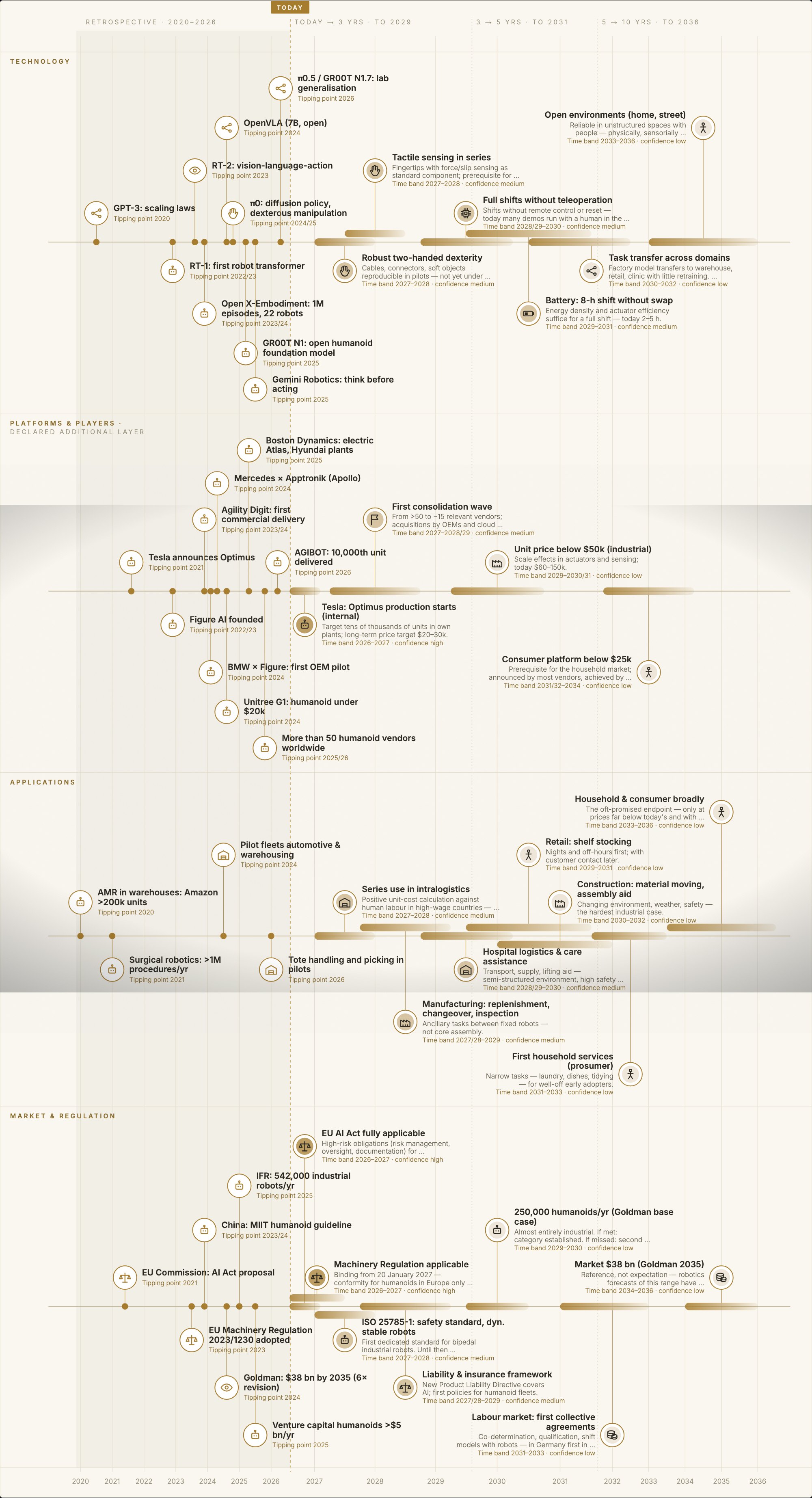
All 52 milestones in four layers with rationale, dependencies, maturity, key figures, ADL classification and recommended action — set for printing at A1 portrait (594 × 841 mm), still legible at A2. Vector PDF, searchable text.
Download PDF (A1, 0.2 MB) Deutsches PDF PNG preview
Sharing within organisations welcome; modification and commercial re-use only with permission.
1 Executive Summary
Robotics is not a new field — industrial robots have been working in factories for sixty years, and in 2024 a record 542,000 new ones were installed worldwide, twice as many as ten years earlier. What is new is something else: robots are beginning to generalise. Vision-language-action models — foundation models that see, understand language and produce motor commands — are replacing the programming of individual movements. A robot that has learned a task transfers it to similar ones without being reprogrammed.
That shifts the question from "What can a robot do?" to "What can a robot learn?" — and suddenly makes the humanoid form economically sensible: whoever wants to generalise in human-made environments has the least adaptation effort with a human shape. That is why capital has been flowing into humanoid platforms at scale since 2024, why Goldman Sachs raised its 2035 market forecast sixfold in 2026, why pilot fleets are running at BMW, Mercedes and Amazon.
Who is this relevant for? In the short term for manufacturing and intralogistics, where structured environments and clear tasks carry pilot projects. In the medium term for every industry with repetitive physical work in human-made spaces — retail, healthcare, construction. And for everyone who has so far treated robotics as "solved and outsourced": the boundary between automation and workforce is moving, and with it cost structures, location logic and regulation.
2 Roadmap: retrospective → today → 3 → 5 → 10 years
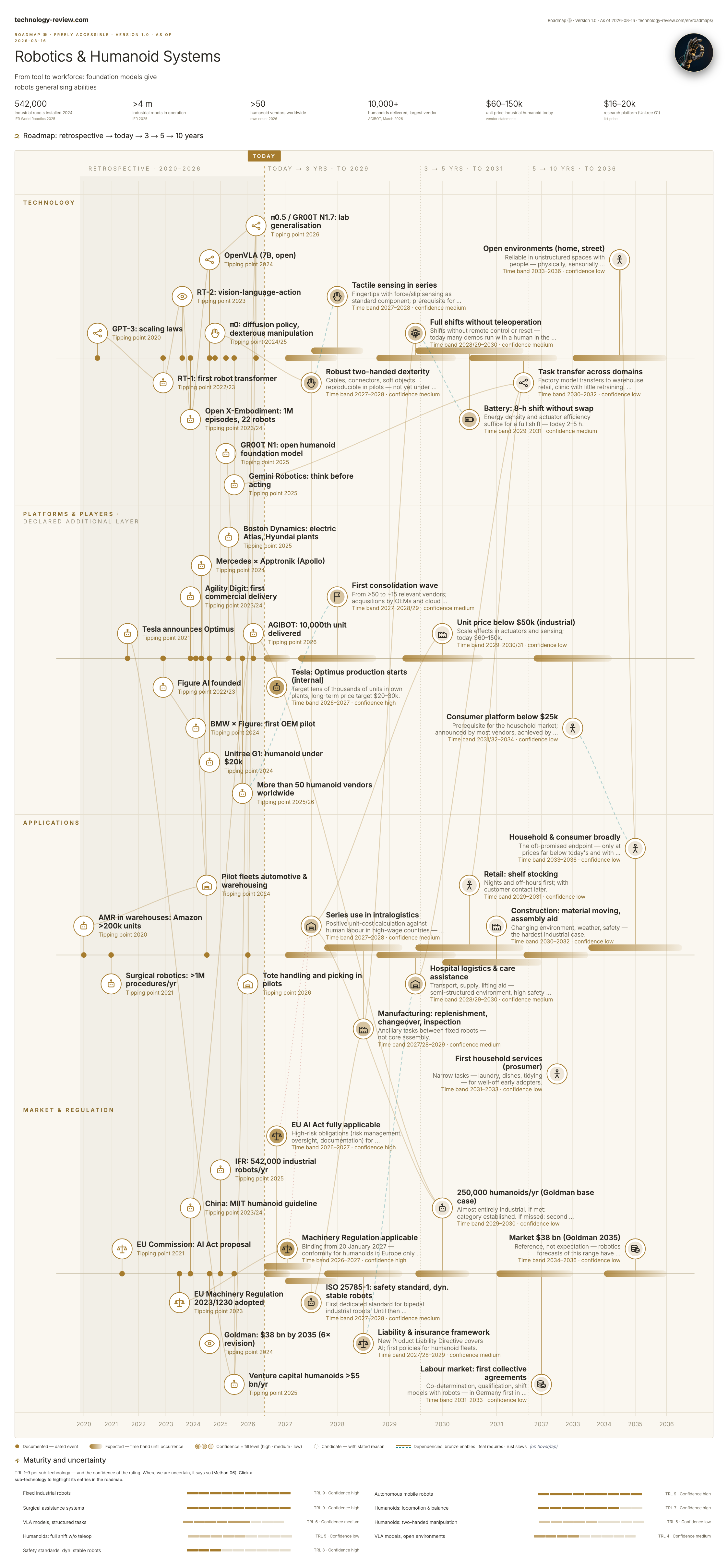
Layers as swim lanes, time axis in declared zones: retrospective · today → 3 · 3 → 5 · 5 → 10 years. Documented items carry filled dots with a dated event; expected items carry time bands, confidence is the fill level of the medallion. Touch an entry: dependency chains appear; click or second tap opens the rationale.
Milestones (text version)
Technology
- GPT-3: scaling laws (2020, belegt, Confidence high)
Large language models show that capabilities scale with data and compute — the assumption later transferred to robots. - RT-1: first robot transformer (2022/23, belegt, Confidence high)
Google shows transformer architectures learning robot actions from 130k episodes and generalising to new tasks. - RT-2: vision-language-action (2023, belegt, Confidence high)
Web knowledge from VLMs flows into motor control: robots follow instructions about objects never seen in training. - Open X-Embodiment: 1M episodes, 22 robots (2023/24, belegt, Confidence high)
Cross-platform dataset; RT-X models learn from other robots. Foundation of generalisation. - OpenVLA (7B, open) (2024, belegt, Confidence high)
First open VLA model at RT-2 level; lowers the entry barrier for research and mid-sized firms. - π0: diffusion policy, dexterous manipulation (2024/25, belegt, Confidence high)
Physical Intelligence: folding laundry, assembling boxes — dexterity from flow matching instead of rules. - GR00T N1: open humanoid foundation model (2025, belegt, Confidence high)
NVIDIA: system-1/system-2 architecture, trained on egocentric video and simulation. Reference model for the industry. - Gemini Robotics: think before acting (2025, belegt, Confidence high)
Google DeepMind couples language planning with motor control; model 1.5 (2026) with motion transfer across platforms. - π0.5 / GR00T N1.7: lab generalisation (2026, belegt, Confidence high)
Success >90 % in structured tasks, marked drop outside training distribution. State today. - Robust two-handed dexterity (2027–2028, erwartet, Confidence medium)
Cables, connectors, soft objects reproducible in pilots — not yet under disturbance. - Tactile sensing in series (2028–2028, erwartet, Confidence medium)
Fingertips with force/slip sensing as standard component; prerequisite for grasp robustness. - Full shifts without teleoperation (2029–2030, erwartet, Confidence medium)
Shifts without remote control or reset — today many demos run with a human in the loop. - Battery: 8-h shift without swap (2030–2032, erwartet, Confidence medium)
Energy density and actuator efficiency suffice for a full shift — today 2–5 h. - Task transfer across domains (2030–2032, erwartet, Confidence low)
Factory model transfers to warehouse, retail, clinic with little retraining. The actual generalisation. - Open environments (home, street) (2033–2036, erwartet, Confidence low)
Reliable in unstructured spaces with people — physically, sensorially, regulatorily the highest hurdle.
Platforms & players
- Tesla announces Optimus (2021, belegt, Confidence high)
AI Day 2021 — a person in a suit. The moment capital starts flowing into humanoids. - Figure AI founded (2022/23, belegt, Confidence high)
Series A/B 2023/24 with OpenAI, Microsoft, NVIDIA; 2025 valuation >$30 bn. - Agility Digit: first commercial delivery (2023/24, belegt, Confidence high)
RoboFab in Oregon (capacity 10,000/yr), deployed at GXO and Amazon. - BMW × Figure: first OEM pilot (2024, belegt, Confidence high)
Spartanburg — Figure 02, later 03; material handling in ten-hour shifts. Most robust industrial evidence. - Mercedes × Apptronik (Apollo) (2024, belegt, Confidence high)
Validation at European sites: logistics, ergonomic relief. - Unitree G1: humanoid under $20k (2024, belegt, Confidence high)
Chinese price breaker — research platform for universities worldwide; IPO 2026. - Boston Dynamics: electric Atlas, Hyundai plants (2025, belegt, Confidence high)
From hydraulic research robot to electric series platform with factory deployment. - More than 50 humanoid vendors worldwide (2025/26, belegt, Confidence high)
Majority in China (AGIBOT, UBTech, Fourier, Unitree, Xpeng), USA (Figure, Tesla, Agility, Apptronik, 1X), Europe (Neura, PAL). - AGIBOT: 10,000th unit delivered (2026, belegt, Confidence high)
First five-digit volume by a single vendor — China leads on units. - Tesla: Optimus production starts (internal) (2027–2027, erwartet, Confidence high)
Target tens of thousands of units in own plants; long-term price target $20–30k. - First consolidation wave (2027–2029, erwartet, Confidence medium)
From >50 to ~15 relevant vendors; acquisitions by OEMs and cloud providers. - Unit price below $50k (industrial) (2029–2031, erwartet, Confidence low)
Scale effects in actuators and sensing; today $60–150k. - Consumer platform below $25k (2032–2034, erwartet, Confidence low)
Prerequisite for the household market; announced by most vendors, achieved by none.
Applications
- AMR in warehouses: Amazon >200k units (2020, belegt, Confidence high)
Autonomous mobile robots are standard — the base technology on which humanoids build. - Surgical robotics: >1M procedures/yr (2021, belegt, Confidence high)
Da Vinci and successors in clinical routine; autonomous sub-steps in trials. - Pilot fleets automotive & warehousing (2024, belegt, Confidence high)
BMW, Mercedes, Amazon, GXO, Hyundai — documented, each a narrow task. - Tote handling and picking in pilots (2026, belegt, Confidence high)
First tasks with measurable throughput against human benchmarks. - Series use in intralogistics (2027–2028, erwartet, Confidence medium)
Positive unit-cost calculation against human labour in high-wage countries — night shifts and ergonomics cases first. - Manufacturing: replenishment, changeover, inspection (2028–2029, erwartet, Confidence medium)
Ancillary tasks between fixed robots — not core assembly. - Hospital logistics & care assistance (2029–2030, erwartet, Confidence medium)
Transport, supply, lifting aid — semi-structured environment, high safety requirements. - Retail: shelf stocking (2030–2032, erwartet, Confidence low)
Nights and off-hours first; with customer contact later. - Construction: material moving, assembly aid (2030–2032, erwartet, Confidence low)
Changing environment, weather, safety — the hardest industrial case. - First household services (prosumer) (2032–2034, erwartet, Confidence low)
Narrow tasks — laundry, dishes, tidying — for well-off early adopters. - Household & consumer broadly (2034–2036, erwartet, Confidence low)
The oft-promised endpoint — only at prices far below today's and with open-environment capability.
Market & regulation
- EU Commission: AI Act proposal (2021, belegt, Confidence high)
First legal framework for AI systems; AI robots later classed as high-risk. - EU Machinery Regulation 2023/1230 adopted (2023, belegt, Confidence high)
Replaces the Machinery Directive; cybersecurity and AI-safety requirements for the first time. Applies from January 2027. - China: MIIT humanoid guideline (2023/24, belegt, Confidence high)
Industrial-policy goal: mass production by 2025, world leadership by 2027. State-coordinated supply chain. - Goldman: $38 bn by 2035 (6× revision) (2024, belegt, Confidence high)
From $6 bn to $38 bn — reasoning: end-to-end training and falling manufacturing costs. - IFR: 542,000 industrial robots/yr (2025, belegt, Confidence high)
Record installations 2024, stock >4 m. The established market humanoids grow into. - Venture capital humanoids >$5 bn/yr (2025, belegt, Confidence high)
Figure, Physical Intelligence, Skild, 1X, Apptronik — funding rounds in the billions. - EU AI Act fully applicable (2027–2027, erwartet, Confidence high)
High-risk obligations (risk management, oversight, documentation) for AI-controlled robots. - Machinery Regulation applicable (2027–2028, erwartet, Confidence high)
Binding from 20 January 2027 — conformity for humanoids in Europe only with AI-safety evidence. - ISO 25785-1: safety standard, dyn. stable robots (2027–2028, erwartet, Confidence medium)
First dedicated standard for bipedal industrial robots. Until then case-by-case assessment — a brake for Europe. - Liability & insurance framework (2028–2029, erwartet, Confidence medium)
New Product Liability Directive covers AI; first policies for humanoid fleets. - 250,000 humanoids/yr (Goldman base case) (2030–2030, erwartet, Confidence low)
Almost entirely industrial. If met: category established. If missed: second consolidation. - Labour market: first collective agreements (2031–2033, erwartet, Confidence low)
Co-determination, qualification, shift models with robots — in Germany first in automotive. - Market $38 bn (Goldman 2035) (2034–2036, erwartet, Confidence low)
Reference, not expectation — robotics forecasts of this range have historically been almost always too early.
3 ADL classification — per reference industry
Emerging · pacing · key · base technology. The classification is relative to an industry and is therefore reported per reference industry (Method 04).
| Sub-technology | Automotive & suppliers | Logistics & retail | Healthcare | Software companies |
|---|---|---|---|---|
| Fixed industrial robots Six decades old; base in manufacturing, still differentiating in clinics (surgery). | Base | Base | Key | Base |
| Autonomous mobile robots (AMR) Standard in warehouses, decisive for material flow in manufacturing, being built up in hospitals. | Key | Key | Pacing | Base |
| Surgical & precision robotics Key technology in clinical routine for healthcare; irrelevant to all others. | Emerging | Emerging | Key | Emerging |
| Robot foundation models (VLA) Already key for software companies (the model is the product); pacing for users. | Pacing | Pacing | Emerging | Key |
| Humanoid platforms Beginning to change competition in manufacturing and logistics; no robust use case in healthcare yet. | Pacing | Pacing | Emerging | Pacing |
| Dexterous manipulation (hands, tactile) The bottleneck behind all humanoid applications. Whoever masters it sets the pace. | Pacing | Pacing | Pacing | Pacing |
4 Maturity and uncertainty
TRL 1–9 per sub-technology — and the confidence of the rating. Where we are uncertain, it says so (Method 06). Click a sub-technology to highlight its entries in the roadmap.
- Fixed industrial robotsTRL 9 · Confidence highIFR: 542,000 installations in 2024, >4 m in operation.
- Autonomous mobile robotsTRL 9 · Confidence highSeries use in warehouses (Amazon, DHL and others), standard products from several vendors.
- Surgical assistance systemsTRL 9 · Confidence highClinical routine; autonomous sub-steps in trials (TRL 6–7).
- Humanoids: locomotion & balanceTRL 7 · Confidence highDemonstration in relevant environment (BMW, Amazon); vendor figures on success rates, few independent measurements.
- VLA models, structured tasksTRL 6 · Confidence mediumLab validation; published benchmarks (OpenVLA, π0.5) show a marked drop outside the training distribution.
- Humanoids: two-handed manipulationTRL 5 · Confidence lowPrototypes in deployment settings over months (Figure, Agility, Apptronik); falls rare but documented.
- Humanoids: full shift w/o teleopTRL 5 · Confidence lowPredominantly vendor videos; independent reproduction largely missing. Confidence deliberately low.
- VLA models, open environmentsTRL 4 · Confidence mediumShare of teleoperated sequences in demos is rarely disclosed; BMW ten-hour shifts are the most robust evidence.
- Safety standards, dyn. stable robotsTRL 3 · Confidence highISO 25785-1 in the standardisation process (2026/27), until then case-by-case assessment — TRL here to be read as "maturity of the rulebook".
No highlight active.
5 Implications for action
Per time horizon: watch · pilot · invest · ignore — with reasons. Formulated for the reference industries; the assumptions are disclosed so they can be transferred.
Whoever has a structured, repetitive, physically demanding task with a clear start and end state should pilot now — not to save costs (a pilot does not do that yet) but to build integration knowledge: safety concept, IT connection, works council, maintenance. Whoever starts in 2029 is three years behind on exactly that knowledge.
For semi-structured environments, robust use cases are lacking. Watching means concretely: name two vendors, review their reference projects every six months, and go through your own task list for "structured enough for 2029".
Once the milestones "full shifts without teleoperation" and "ISO 25785-1 adopted" have occurred — both verifiable — the calculation tips from pilot to roll-out. Investing then means: fleet, not single unit; and adapting the task architecture of your own processes to the capabilities rather than the other way round.
Domain transfer decides. If it occurs, the factory experience is transferable; pilots in clinic logistics and shelf stocking then become sensible.
On reaching the Goldman base case (250,000/yr in 2030) the category is established; prices fall, vendors consolidate, standards stand. Whoever has only watched until then buys standard products — which is fine, but no longer brings a lead.
The household robot is the most frequently promised and least often delivered application. Not plannable as a separate line of business for non-robot-makers before 2034. Ignoring does not mean disdaining — it means not tying up resources.
6 Change journal
What has shifted since the last update — dated, cumulative, including misjudgements. The core of the subscription.
- 2026-08-16 First edition
Roadmap v1.0 based on the source situation to August 2026. Starting assumptions: VLA models generalise in the lab (TRL 6 in structured tasks), pilot fleets at BMW/Mercedes/Amazon documented, Goldman revision to $38 bn (2035) adopted as a reference. Most important open question: the share of teleoperated sequences in vendor demos — confidence of the manipulation milestones therefore deliberately low.
7 Sources
Market data
- International Federation of Robotics (2025): World Robotics 2025 — Industrial Robots. 542,076 installations in 2024; forecast 575,000 (2025), >700,000 (2028). ifr.org/worldrobotics/report-2025
- Goldman Sachs Research (2026): Humanoid Robot — The AI Accelerant. Revision of the 2035 forecast to $38 bn; base case >250,000 units in 2030.
Technology
- NVIDIA (2025): GR00T N1: An Open Foundation Model for Generalist Humanoid Robots. arXiv:2503.14734.
- Physical Intelligence (2025): π0.5 — vision-language-action with diffusion policy; Google DeepMind (2025/26): Gemini Robotics 1.5.
- Kim, M. J. et al. (2024): OpenVLA: An Open-Source Vision-Language-Action Model. Stanford/TRI.
Deployments (vendor statements, partly independently confirmed)
- BMW Group / Figure AI: pilot operation Figure 02/03 at Spartanburg since 2024, material handling in ten-hour shifts.
- Mercedes-Benz / Apptronik: Apollo validation at several European sites 2025/26 (logistics, ergonomic relief).
- Agility Robotics: Digit in Amazon logistics centres, >100,000 cycles (vendor figure).
- AGIBOT: 10,000th unit delivered March 2026; Tesla: Optimus production from summer 2026, internal.
Regulation
- Regulation (EU) 2024/1689 (AI Act), fully applicable August 2026; Regulation (EU) 2023/1230 (Machinery Regulation), applicable from 20 Jan 2027.
- ISO/WD 25785-1: Robotics — Safety requirements for dynamically stable industrial mobile robots. In the standardisation process.
Signals
- Ongoing signal feed from squawk.de (category robotics/AI) and the pipeline's scanning; see change journal.
Methods used
Technology Scanning · S-Curve Analysis · Lifecycle & ADL · Technology Roadmapping · Maturity Assessment (TRL) · Scenario Technique · Patent & Publication Analysis